
Overview Of Proteobacteria
Proteobacteria is the second largest group of bacteria. This phylum contains 1534 species or 32.3% of all known bacteria. Proteobacteria are all gram negative, but otherwise represent a diverse range of organisms such as the Purple phototrophic, Nitrifying bacteria and Enteric bacteria as well as the bacteria responsible for animal bioluminescence.
- The Proteobacteria are a major group (phylum) of bacteria.
- All proteobacteria are Gram-negative, with an outer membrane mainly composed of lipopolysaccharides.
- The Proteobacteria are divided into six sections, referred to by the Greek letters alpha through zeta, again based on rRNA sequences.
- The divisions of the proteobacteria were once regarded as subclasses (e.g. α-subclass of the Proteobacteria), but are now regarded as classes (e.g. the Alphaproteobacteria).
- Domain: Bacteria, Kingdom: Eubacteria, Phylum: Proteobacteria, Class: Gammaproteobacteria, Order: Enterobacteriales, Family: Enterobacteriaceae, Genus: Escherichia, Species: E. Coli.
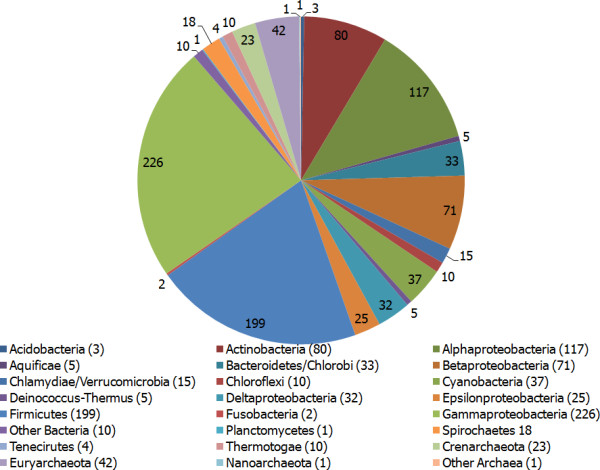
Fig-1
The pie-chart represents distribution of microbial organisms in the dataset. For proteobacteria, the classes within this phylum are labelled. For all other phyla only the phylum name is shown.
Source-bmcbioinformatics.biomedcentral.com